



A home abroad begins as a property search. In practice, it becomes a decision about time, family, capital and the life you intend to lead. The property matters, of course. So do the rules around it.
In brief: Buying property overseas begins with three questions: what the home is for, what it will truly cost, and who is protecting your interests. Once those answers are clear, the process becomes a matter of sequence: understand the market, verify the legal position, arrange the funds and complete the purchase without allowing urgency to dictate the decision.
Perhaps the idea began during a long lunch above the Mediterranean, or on an Amsterdam morning when the canals were still and the city seemed unusually persuasive. Soon afterwards, the browser tabs multiplied. A house in Mallorca. An apartment in Paris. Something quieter outside Lisbon. Three versions of the same villa, listed by three agencies at three different prices.
That is usually the point at which aspiration meets the international property market.
Buying a home in another country is entirely manageable, provided the sequence is right. The difficulty is that each market has its own contracts, taxes, professional roles and local habits. Much of the available guidance is also written by a party with something to sell. The listing agent, mortgage provider and currency company each serve a defined commercial role. None replaces someone whose responsibility is the buyer’s position.
The process becomes considerably clearer once you understand what must happen, in what order, and who should be responsible for each part.
The first step is not choosing a property. It is deciding what that property must do for you.
A family residence used for several weeks each summer requires a different search from a European business base, a future primary home or an income-producing asset. Each creates its own priorities around access, privacy, maintenance, rental potential and long-term flexibility.
Begin with four decisions: purpose, location parameters, timing and total budget. The budget should extend beyond the purchase price to include taxes, professional fees, immediate works, furnishing, annual ownership costs, currency exposure and a realistic contingency.
Next, consider how the property will fit into your life. A house that requires two flights, a ferry and a seasonal road may still be remarkable, but spontaneity will not be among its strengths. By contrast, a city apartment might offer excellent connectivity while delivering less space, privacy and flexibility for longer family stays.
A clear brief protects you from one of the most common mistakes in international property buying: choosing the most impressive home viewed rather than the home that best supports the original objective.
Many established European markets permit foreign buyers to acquire residential property. However, the rules are not uniform.
Switzerland generally restricts purchases by foreign non-residents under its Lex Koller regime. Austria applies rules at federal-state level, while agricultural land, protected properties, border areas and designated second-home zones may carry additional restrictions elsewhere.
Nationality is therefore only one part of the picture. Residence status, intended use, property type and ownership structure may all influence what you can buy and under which conditions.
Owning a property also does not automatically provide the right to live in the country throughout the year. Spain ended its investor residence route, including the property-linked option, in April 2025. Portugal removed real estate from its qualifying investment residence routes in 2023. Greece continues to offer a property-linked option, although higher investment thresholds now apply in several sought-after locations.
The residency question should be addressed alongside the property search, particularly when the home is intended for full-time use, retirement or extended stays.
Ownership structure deserves equal attention. Purchasing personally, jointly, through a company or through another legal arrangement can affect taxation, succession, reporting and future sale. These decisions should be made before an offer, rather than retrofitted once a property has already been selected.

Once you know what you are looking for and where you stand legally, the rest of the process becomes much easier to navigate. The details vary by country, but the overall steps are usually similar.
Independent legal advice is the starting point. Your lawyer should verify the title, review contracts, identify legal risks and explain your obligations under local law. They should represent you alone, rather than the developer, listing agency or seller.
A Personal Property Advisor serves a different but equally important function. The lawyer protects the legal position. The advisor protects the search, commercial judgement, negotiation strategy and continuity of the purchase.
This distinction matters in markets where a seller’s representative may present themselves as a source of guidance for both sides. They may be knowledgeable, responsive and perfectly professional. Their obligation, however, remains tied to the seller and the successful completion of the sale.
Independent advice begins with understanding who each party represents.
International property portals are useful for learning broad price levels, architecture and geography. They are less reliable as a complete record of available homes.
Listings may be duplicated across several agencies, advertised at different prices or left online after the property has been sold. In the prime segment, some of the strongest opportunities may never appear publicly, instead circulating through trusted local networks, private advisors and established agency relationships.
A disciplined search combines public inventory, direct market access and off-market opportunities. It should also verify listing status, agency relationships and viewing registrations before appointments are arranged.
This matters because the first agency to introduce a buyer to a property may later claim involvement in the transaction. Clear representation from the beginning can reduce confusion over agency registrations and commission rights.
The objective is not to visit the greatest possible number of homes. It is to understand the market well enough that each viewing provides useful evidence.
Non-resident financing is available in many European markets, although lenders often require a larger deposit and more extensive documentation than they would from a domestic buyer.
Income currency, tax residence, age, source of funds, property use and broader asset position may all affect the terms offered. In some markets, banks routinely lend to international buyers. Elsewhere, underwriting can be slower or more conservative.
Possible routes include a mortgage from a bank in the property’s country, international lending through an existing bank, private-bank finance or borrowing against another asset.
The financing process should begin while the search is underway. An agreement in principle helps confirm the working budget, strengthens the buyer’s position and reduces the risk of paying a deposit before the funds are secure.
An offer can be informal in one jurisdiction and legally significant in another. Before signing, submitting or transferring money, confirm the effect of the document with local counsel.
The lawyer should review the proposed conditions, financing provisions, deposit treatment, completion dates and due diligence period. Any assumptions made during negotiations should be reflected in writing.
Once terms are agreed, many European purchases proceed through a reservation document or preliminary contract, followed by a deposit. Five to ten percent is common across several markets, although the amount and legal consequences vary.
A buyer who withdraws outside the agreed conditions may lose that deposit. Equally, a seller who fails to complete may face penalties under the contract. The details depend on local law and the language of the agreement.
Due diligence should examine the ownership, building and intended use of the property.
The legal review typically covers title, mortgages, charges, easements, planning permissions, licences, boundaries and restrictions. For apartments, it may also include condominium records, planned works, reserve funds, service charges, litigation and rental limitations.
A technical inspection should assess structure, moisture, roofing, services, energy performance and recent alterations. Coastal properties may require additional attention to corrosion, drainage and exposure. Rural homes may raise separate questions around road access, water rights, septic systems and land boundaries.
Renovations deserve particular scrutiny. A beautifully finished guesthouse, pool or extension can become a liability when the necessary permissions were never obtained.
The review should also confirm that the property can be used as intended. Local rules may restrict short-term rentals, commercial activity, redevelopment or changes to protected buildings.
Completion procedures vary between countries. In many civil-law jurisdictions, a notary authenticates the deed, verifies defined aspects of the transaction, collects certain taxes and arranges registration.
A notary is impartial. That does not mean they are acting as the buyer’s personal advisor. Your lawyer remains responsible for explaining the legal consequences and protecting your position.
Funds should move only through the regulated channel confirmed by the lawyer, notary or institution handling completion. Payment instructions should always be verified by telephone using a trusted number. Email interception and fraudulent changes to bank details remain a serious risk in high-value transactions.
Currency planning should be handled before completion day. A two percent exchange-rate movement on a €2 million purchase represents €40,000. Depending on the buyer’s circumstances, staged transfers, forward contracts or protected target rates may reduce uncertainty.
Once the deed has been signed, confirm that the ownership has been registered, the relevant taxes have been paid and the full completion file has been retained. These documents may be needed for annual reporting, future finance, succession planning and eventual sale.
The asking price is the starting figure, not the complete budget.
Across Europe’s principal markets, buyers may need to reserve approximately 4 to 13 percent above the purchase price for transfer taxes, stamp duty, VAT where applicable, legal advice, notary and registration charges, surveys and representation.
The final figure depends on the country, region, purchase price, property type and intended use. New-build properties may follow a different tax treatment from resales. Primary residences may also receive different treatment from second homes or investment properties.
The following figures are indicative planning ranges and should be confirmed before an offer is submitted.
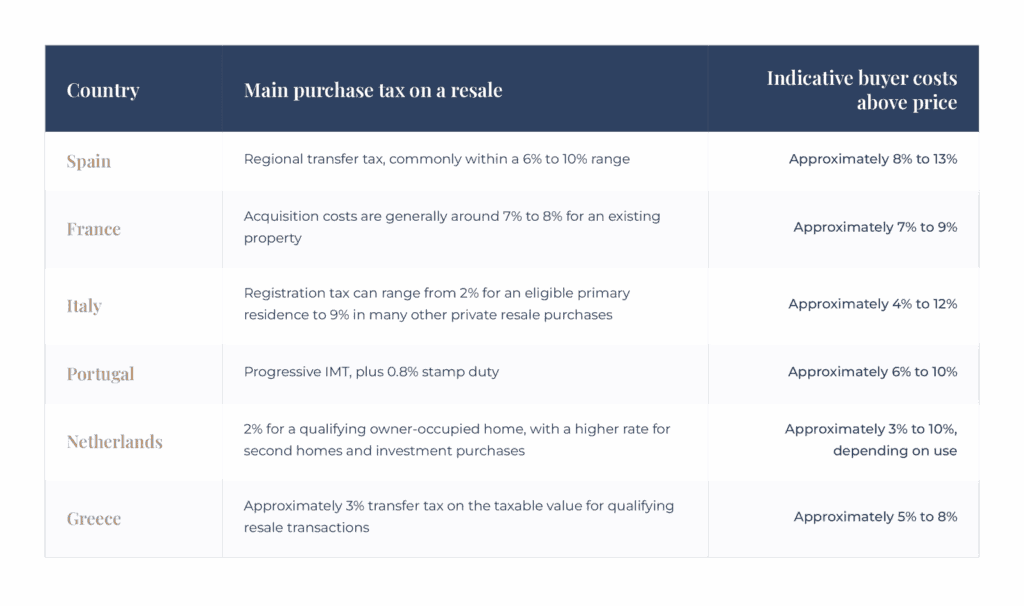
Annual ownership costs should be considered at the same stage. These may include municipal property tax, service charges, insurance, maintenance, utilities, security, management and tax on rental income.
A home that appears relatively economical to acquire can be expensive to maintain, particularly when it includes extensive grounds, shared amenities, private access roads, marine exposure or permanent staff requirements.
The cost of necessary works should also be assessed before completion. A survey can identify defects, but the buyer still needs credible estimates and an understanding of local contractor availability. In highly seasonal destinations, the timing of works can be as important as the price.
A cross-border property can create obligations in the country where it is located and in the buyer’s country of tax residence.
Transfer tax, stamp duty or VAT may apply at acquisition. During ownership, the buyer may face annual property taxes and tax on rental income. Capital gains, withholding, succession and wealth-related taxes can become relevant later.
Tax planning should therefore cover the purchase, ownership period, succession intentions and likely exit.
For US persons, foreign rental income and capital gains may need to be reported to the Internal Revenue Service. Foreign financial accounts may also create reporting obligations when the combined value exceeds the applicable threshold.
Direct ownership of foreign property is generally treated differently from holding an overseas bank account or owning the property through a foreign entity. The structure matters, and advice should be obtained before funds are transferred.
Double-taxation treaties can reduce the risk of the same income being taxed twice, but they do not remove the need for filing and documentation. A cross-border tax specialist should review the position in both jurisdictions.
The expensive errors are rarely unusual. They are generally ordinary decisions made too quickly.
The first is allowing the property to dictate the structure. A buyer finds a home, agrees the commercial terms and only then asks how it should be owned.
The second is relying on the seller’s side for the full picture. A listing agent can explain the property and support the transaction. Their role is still to represent the seller and achieve a successful sale.
The third is treating online inventory as the complete market. Duplicate and outdated listings can distort price expectations, while private opportunities remain invisible.
Another common issue is focusing on title and tax while underestimating the building itself. Moisture, coastal corrosion, retaining walls, ageing services and unauthorised works can materially change the economics of the purchase.
Buyers can also lose control of the budget by leaving the currency conversion until completion. Exchange rates can move while legal work is underway, turning an agreed purchase price into a changing financial commitment.
Finally, an impressive address cannot correct a weak decision. The strongest overseas purchase is the property that suits the brief, survives due diligence and remains convincing once the excitement of the first viewing has passed.

While a Personal Property Advisor does not replace your lawyer, tax specialist, surveyor or lender, their role is to ensure that each expert is working towards the same objective: the right property, acquired on the right terms, without losing sight of your original brief.
They provide continuity across a process that can otherwise become fragmented. From defining the search and accessing suitable properties to assessing value, negotiating terms and coordinating due diligence, your advisor keeps the wider strategy intact while each specialist addresses their own area of expertise.
This is particularly important when buying overseas. Different legal systems, unfamiliar market practices and several professional parties can quickly blur responsibilities and slow decisions. Advice may arrive from multiple directions, yet no individual specialist is necessarily responsible for the entire picture.
A Personal Property Advisor gives you one independent point of contact who understands the full purchase, represents your interests and ensures that decisions remain connected to the original objective.
They can challenge asking prices against market evidence, identify gaps in the information provided, coordinate viewings, manage communication between parties and bring the correct specialist into the process when a question falls outside their own expertise.
That independence also matters during negotiation. The advisor is not trying to protect the seller’s position or secure a listing commission. Their responsibility is to assess the opportunity from the buyer’s perspective and advise accordingly, including when the correct recommendation is to step away.
For Baerz & Co clients, that support begins before the first viewing and continues until the property has been successfully transferred.
Learning how to buy property overseas is less about mastering every local procedure and more about controlling the sequence.
Define the purpose. Confirm the legal position. Set the complete budget. Appoint independent advisors. Search beyond public listings. Arrange the funds early. Examine the property legally, technically and commercially. Complete the purchase through verified channels and retain the full record.
Handled properly, the process should feel measured rather than dramatic. The drama belongs in the view, the architecture and the first evening with the doors open. It has no useful place in the contract.
A Baerz & Co Personal Property Advisor can coordinate the search and purchase from the buyer’s side, drawing on local market expertise while keeping one clear brief at the centre of every decision.
Yes. US citizens can purchase residential property in many European countries, including the Netherlands, Spain, France, Italy, Portugal and Greece. Restrictions may apply to certain locations, land categories or property types. Switzerland and parts of Austria require particular care. Property ownership does not automatically grant residency, so immigration rules should be reviewed separately.
There is no single easiest country. The Netherlands, Portugal, Spain, France, Italy and Greece all have established transaction systems, but the costs, financing requirements and local procedures differ. The smoother purchase is usually the one supported by reliable local counsel, clear documentation and independent buyer-side representation.
Usually not. Ownership and residency are separate legal matters. Spain ended its investor visa route in April 2025, while Portugal removed property purchases from its qualifying investment residence routes in 2023. Greece continues to offer a qualifying property route, although higher minimum investment thresholds apply in several high-demand areas.
Yes, although non-resident borrowers may face lower loan-to-value ratios, stricter affordability tests and additional documentation. Options can include a local mortgage, international lending, private-bank finance or borrowing against another asset. The financing process should begin before an offer is made, particularly when the preliminary contract places the deposit at risk.
A straightforward European purchase often takes around three to six months from an accepted offer to completion. Timing depends on the country, financing, legal checks, surveys, planning records and the readiness of each party. A financed purchase involving title issues, renovation permits or a complex ownership structure may take longer.


























 Dutch
Dutch  German
  Spanish
  French
  Arabic
  Chinese
  Russian
  Swedish
  Portuguese
  Polish
  Greek
Greek  Italian
